
Le codage médical intégré à vos comptes rendus
Avec Nabla, documentation médicale et codage vont de pair. Pendant que vous échangez avec votre patient, l'outil prépare votre compte rendu et y propose les codes adaptés.


Un bon codage commence par un compte rendu complet
Les outils de codage relèguent souvent le compte rendu au second plan.
Nabla en fait le point de départ. Il tient compte de la complexité des décisions médicales et rassemble les éléments cliniques dont la CIM-10 a besoin, avant même que vous ne choisissiez un code.
Chaque suggestion est justifiée par ce que vous avez consigné dans le dossier.
Le codage médical ne devrait pas vous prendre autant de temps
Trouver le bon code, vérifier les règles, compléter le dossier : une fois la consultation terminée, le travail continue. Sans accompagnement dédié, ces tâches s'accumulent et finissent par peser sur votre temps.
Résultat :
Un codage précis,
et toujours justifié
Aide au codage CIM-10
Nabla propose des codes de diagnostic à partir de votre compte rendu et du contexte de la consultation.
Des comptes rendus pensés pour le codage
Les éléments cliniques et les justifications du codage sont structurés directement dans le document.
Vous gardez la main
Nabla suggère, vous décidez : vous relisez chaque proposition et ne retenez que les codes qui correspondent à votre consultation.
Un codage fiable, évalué par des experts
Pour valider un code, vous devez pouvoir comprendre ce qui le justifie. Nabla relie chaque suggestion aux éléments cliniques consignés pendant la consultation : vous en vérifiez la pertinence, et la décision finale vous revient.

University of Toledo Health déploie Nabla à grande échelle après avoir amélioré la précision de sa documentation clinique et la performance de son cycle de facturation

Rédiger et coder devient plus simple avec Nabla
En réunissant rédaction du compte rendu et suggestions de codes dans un même outil, Nabla simplifie votre travail pour vous permettre de rester pleinement concentré sur votre patient. Les codes proposés s’appuient sur les informations cliniques recueillies, et vous gardez la main sur leur validation.
Revenue integrity starts with the note
Better documentation for clinicians means revenue for the care delivered. Nabla gets the note and code right before signing.
Talk to our team


Small gaps in the note become big gaps downstream
Reimbursement depends on what’s documented, not just the care provided.
One incomplete note can mean a CDI query, coder rework, a resubmission and more days in A/R.
In a 2025 AAPC audit of roughly 40,000 claims across 25 organizations, the two most common failures were conditions documented without MEAT and diagnoses lacking specificity.
AAPC® is a registered trademark of AAPC.
Start with the clinical conversation
Coders, auditors and payers review the chart after it’s signed. Nabla drafts it from the conversation, so it can surface coding details while the clinician is still there to confirm them.
Talk to sales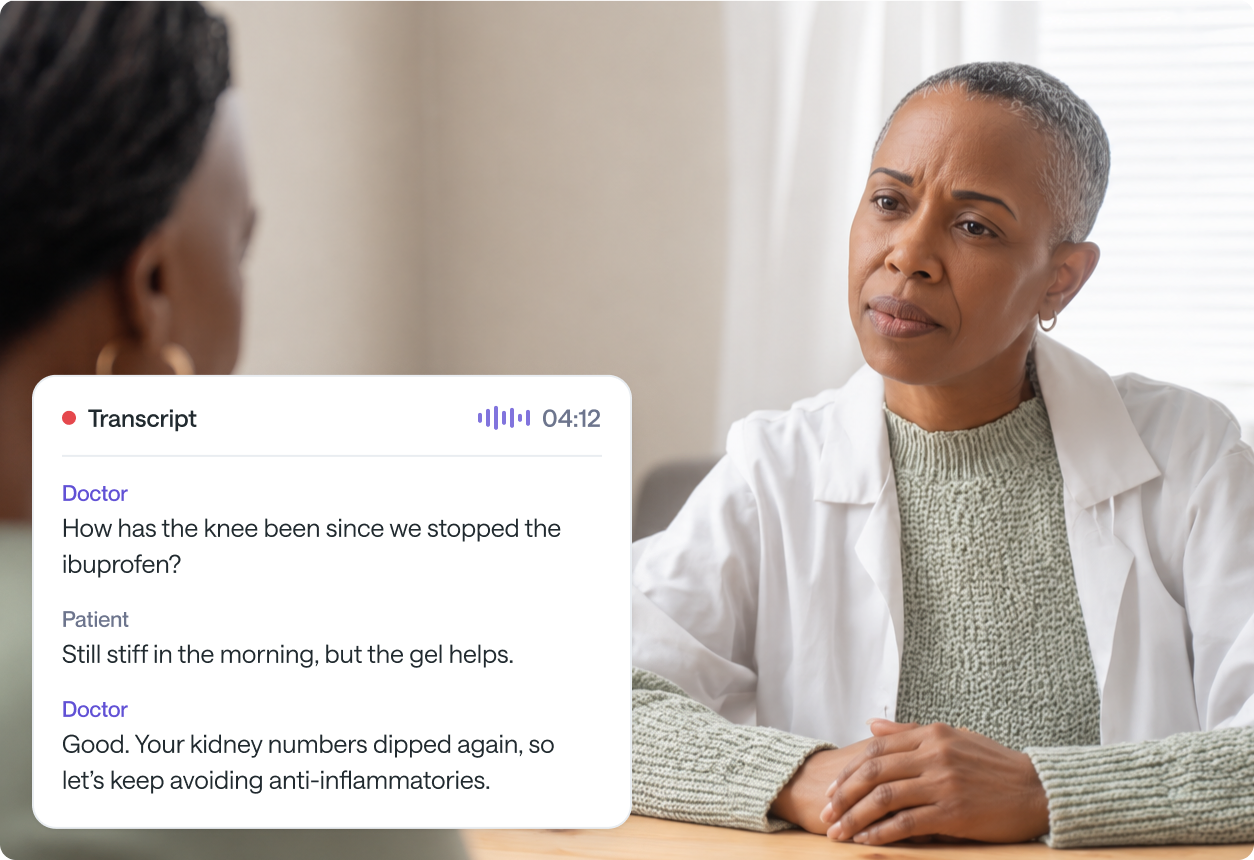

Coding support at every stage of the note
Runs inside your EHR, alongside your existing coding tools.
While the note is written
Suggests ICD-10-CM codes for each problem in the Assessment & Plan, as specific as the note allows.
Suggests the E/M level from the documented medical decision making. Shows the reasoning behind problems, data and risk, and checks for supported add-on codes.
E/M coding agreement with expert coders.
When a detail is missing
Flags a missing detail, such as laterality, stage or subtype, before the encounter closes. One click updates both the note and the code.
Designed against 2026 AHIMA/ACDIS query guidelines.
One last check before signing
Checks that existing HCC diagnoses have enough supporting documentation (MEAT). Flags weak support without adding or changing codes.
Every supporting quote is checked against the note.
Less to fix with a more comprehensive note
What coders, payers and auditors receive: a note that already supports the code.
University of Toledo Health Scales Nabla's Ambient AI After Unlocking Better Documentation Precision and Revenue Cycle Performance
Revenue Starts in the Exam Room: Lessons from KeyCare and Codman Square on AI, Documentation, and Coding
22.9% to 7.9%
Grounded in the note. Controlled by the clinician.
Every suggestion is grounded in the documentation and stays under the clinician’s control. Accuracy means the right level, up or down.

Never adds a diagnosis that isn’t documented

Non-leading nudges, with no reimbursement language

Nothing changes without a clinician’s click

The reasoning behind every suggestion stays on record
AAPC® is a registered trademark of AAPC.
Frequently asked questions
No. Nabla suggests codes within the clinician’s workflow. The clinician confirms them, and codes flow through your existing coding and billing process.
No. Codes follow what the note documents, in both directions. E/M Coding Assist credits only the MDM in the note, Specificity Nudges show every valid option equally, and HCC Documentation Review never adds a code.
No. Coders still review, audit and handle complex cases. Nabla gives them a more complete note to start from, so they spend less time on queries and rework.
No, on purpose. It checks that the conditions your clinicians address are well documented, and it never suggests a new diagnosis. Your suspecting tools keep doing their job.
Specificity Nudges were designed against the 2026 AHIMA/ACDIS query guidelines. They’re non-leading, use only the current visit, never mention reimbursement, and the clinician decides.
E/M Coding Assist covers 8 specialties: Family Medicine, General Medicine, Internal Medicine, Pediatrics, Neurology, Cardiology, Psychiatry and Emergency Medicine. ICD-10 coding and Specificity Nudges work across all specialties. HCC Documentation Review is on by default for primary care, and other clinicians can turn it on.
Documentation and coding should work together
Nabla helps clinicians document care naturally while surfacing coding recommendations grounded in clinical evidence and AMA guidelines — with every final decision in the clinician’s hands.
Talk to our team