
Clinicians have always turned a visit into codes. E/M was the original, and picking a level became an accepted part of the process. HCCs are newer, even within my own career, and they raise the stakes on something smaller: a single diagnosis.
Hierarchical condition categories, or HCCs, are a risk-adjustment model. Specific diagnoses, built on ICD-10 codes, are grouped into categories that help predict a patient’s future healthcare costs. In practice, that means one word in the note can shape the resources and care a patient receives, and how an organization plans around them.
When they arrived, the message came largely from administrators. Use these codes, and when you see this pop-up, make sure you pay attention to it. Honestly, it felt like another unnecessary administrative task. That has changed as HCCs have moved into regular practice. Appropriately capturing the complexity of a patient’s diagnoses helps with resource planning and, down the line, with the staff and wraparound care we can provide for that patient. Once I understood the reasoning behind it, it made sense.
The Search Bar Used to Be Enough
HCCs are a subset of ICD-10 codes, and we’ve always assigned ICD-10 codes to patients. In the past, I chose whichever one came up in the search bar first. “Diabetes, unspecified” was the quickest way to attach it to the patient and move on to the next one, and it didn’t matter as much. With the requirement for improved specificity, it takes more effort to pick the ICD-10 code that maps to the most appropriate HCC.
Diabetes shows how much more. It affects so many organ systems. It might be causing issues with the nerves in the feet, with the kidneys, or diabetic retinopathy in the eye, and each of those carries a different weight. Typing diabetes into the note isn’t enough. It has to be captured in that specific ICD-10 code, and that’s the biggest difference from what many of us did before.
Feedback Is Still Catching Up
HCCs are new enough that the feedback is still maturing. When things go really wrong, the response happens at the system level, with courses, classes, and online modules. The day-to-day coaching often comes from the same documentation department that supports E/M, now looking at the documentation tied to a particular HCC diagnosis. In my experience, most of the feedback was about awareness: did you readdress last year’s HCC codes, yes or no? That’s a “did you do it” question rather than a “did you do it well” question. Health systems that have been in value-based care longer go further, with feedback on how to do it more accurately.
Queries follow the same logic as they do with E/M. My practice hadn’t reached that level yet, but I can imagine how it goes. After a delay of more than a week, it’s much harder to remember what we talked about or where we discussed it. I barely remember what happened in the morning session by the afternoon, let alone one, two, or three weeks later.
The coder faces the other side of the same problem. Whether they’re in-house or contracted, they receive something devoid of clinical context, just words on a page, and have to make decisions from it. There’s an inherent tension between clinician and coder, and much of it comes down to the quality of what’s on that page.
The Right Choice, the Easy Choice
Very few clinicians are motivated by getting the right HCC code. It’s something administration cares about more than the frontline clinician, and there usually isn’t a one-to-one incentive for that specific patient. With E/M, there’s sometimes a trickle-down effect. In my group, for example, one quality metric was the percentage of doctors who reassessed codes, yes or no. But the principle is simple. If you make the task easier to do, it gets done more accurately, and more people do it. It’s about getting docs credit for the work they’re already doing, and making the right choice the easy choice.
A Prompt to Reassess, Versus a Record of What Was Addressed
The existing tools are mostly built around reassessment. Last year the patient had diabetes, and the chance they still have it this year is very high. Many EHRs show a pop-up saying the diagnosis hasn’t been reassessed yet, so you should talk to the patient about it. But that only tells me to address the condition. I still have to discuss it, then document that I discussed it, and then specify the diagnosis the way a coder needs to see it.
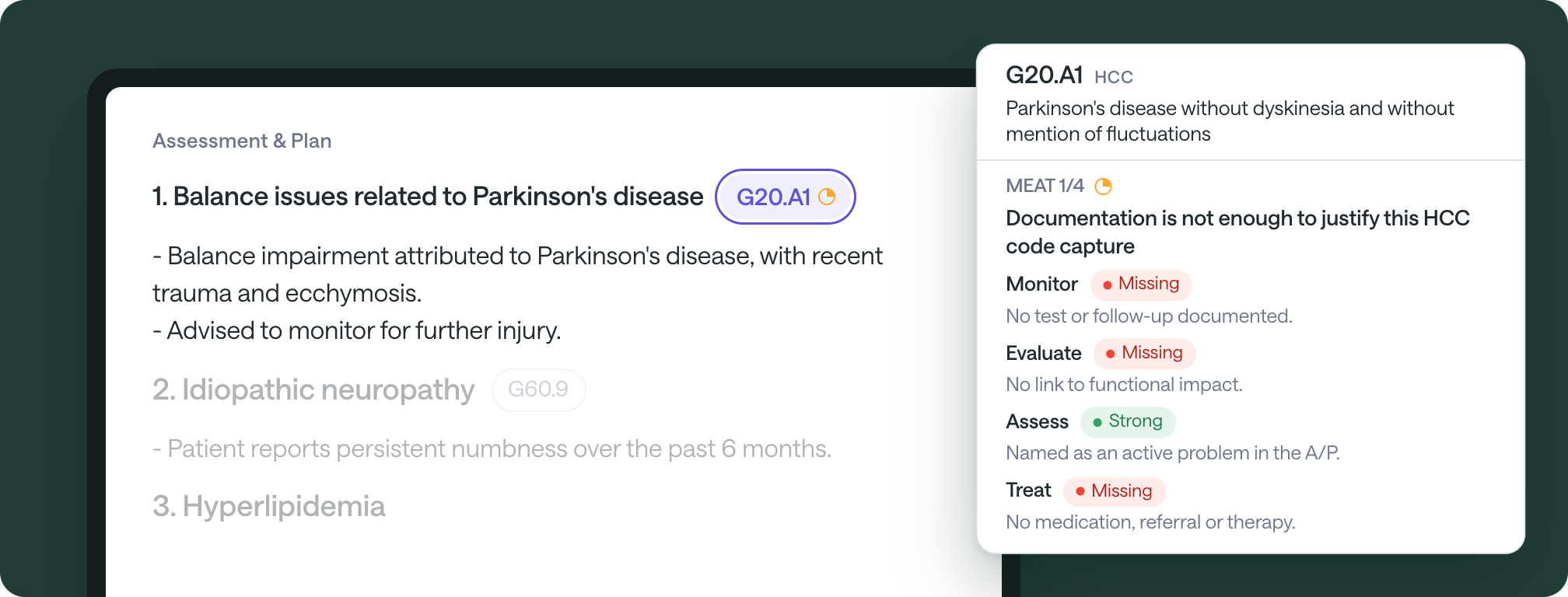
What I like about how this works with Nabla is that it shows me the work was already captured. When I’ve addressed a condition with a patient, the details of that conversation are documented without my having to restate them afterward. That’s been a pleasant surprise, because most clinicians are already addressing these conditions with their patients. We just aren’t trained to document them in the language a coder needs on the back end. Before, I had to recall the MEAT criteria and what the M and the A stood for. Now the conversation I’ve already had is documented accurately and completely.
Like most ambient tools, it lets me focus on the patient, and I think I’m more complete because of it. Telling patients what we’re doing to monitor a condition, and whether it’s improving or staying the same, comes more naturally because I know ambient is capturing it. The visual indicator helps too. Lots of pop-ups telling you what you need to do is a very different experience from seeing what’s been done, and psychologically it’s less of a burden.
I’m usually skeptical of anything that works automatically, at least upfront. What I value is the high level of transparency. It shows why only one or two of the criteria were met, and where in the encounter we talked about it and how it was addressed. I can quickly confirm that yes, we did talk about those things.
All the Extra Stuff
I put all of these tasks in the same category: the extra administrative work that doesn’t directly affect clinical care. They often run together on the same patient. I billed for this visit, and I also made sure I captured these conditions. Having them grouped in a quick checklist makes Nabla a more complete and helpful assistant to the workday.
The goal isn’t more codes. It’s an accurate record of the work that already happened, captured without asking clinicians to do it twice. The more we can make that the easy choice, the more of it gets done well.