From Legacy Dictation to Enterprise AI: How M Health Fairview Scaled Clinical Documentation

By unifying ambient AI and dictation on a single platform, M Health Fairview modernized clinical documentation across the enterprise, simplified governance, and built a repeatable model for AI adoption.
Customer
Snapshot

5,000+
providers
60+
clinics
10
hospitals
Nonprofit
integrated health system
The Challenge
When M Health Fairview began evaluating ambient AI, the goal extended far beyond reducing documentation burden.
Leaders saw an opportunity to modernize clinical documentation across the enterprise. Rather than introducing another standalone solution, they wanted to simplify documentation with a single AI platform that could support clinicians throughout the clinical day while reducing technology complexity.
By replacing legacy dictation tools with Nabla's unified platform, M Health Fairview aimed to create a more consistent clinician experience, streamline training and support, and establish a stronger foundation for governance as adoption expanded across specialties and care settings.
Building a Unified Documentation Strategy
For many health systems, ambient AI becomes another point solution layered onto an already fragmented documentation ecosystem. M Health Fairview chose a different path.
The organization consolidated ambient documentation and medical dictation into a single platform with Nabla, giving clinicians one documentation experience regardless of workflow while reducing the complexity of supporting and managing multiple vendors.
The unified approach also strengthened governance. Clinical informatics, IT, operational leadership, and Nabla established a regular operating cadence to monitor adoption, prioritize enhancements, review clinician feedback, and continuously optimize workflows as the program expanded across the enterprise.
Making Enterprise Adoption Possible
Technology alone doesn't drive transformation. Adoption does.
Recognizing this, M Health Fairview developed a phased implementation strategy designed to build confidence, support clinicians through change, and expand adoption intentionally across the organization.

Phase 1:
Build Momentum
The rollout began with early adopters who demonstrated value within their departments. Clinical rounding, departmental meetings, super users, and peer-to-peer recommendations generated early enthusiasm while creating trusted champions across the organization.

Phase 2:
Modernize Documentation
As momentum grew, M Health Fairview transitioned clinicians from legacy dictation tools to the unified platform through structured enablement. Asynchronous learning, one-on-one efficiency sessions, targeted communications, and ongoing support helped clinicians adopt new workflows while legacy technologies were gradually retired.

Phase 3:
Scale Across the Enterprise
With a repeatable implementation model established, M Health Fairview expanded Nabla beyond primary care into cardiology, emergency medicine, inpatient care, rehabilitation, pharmacy, nursing, care coordination, and other clinical settings.
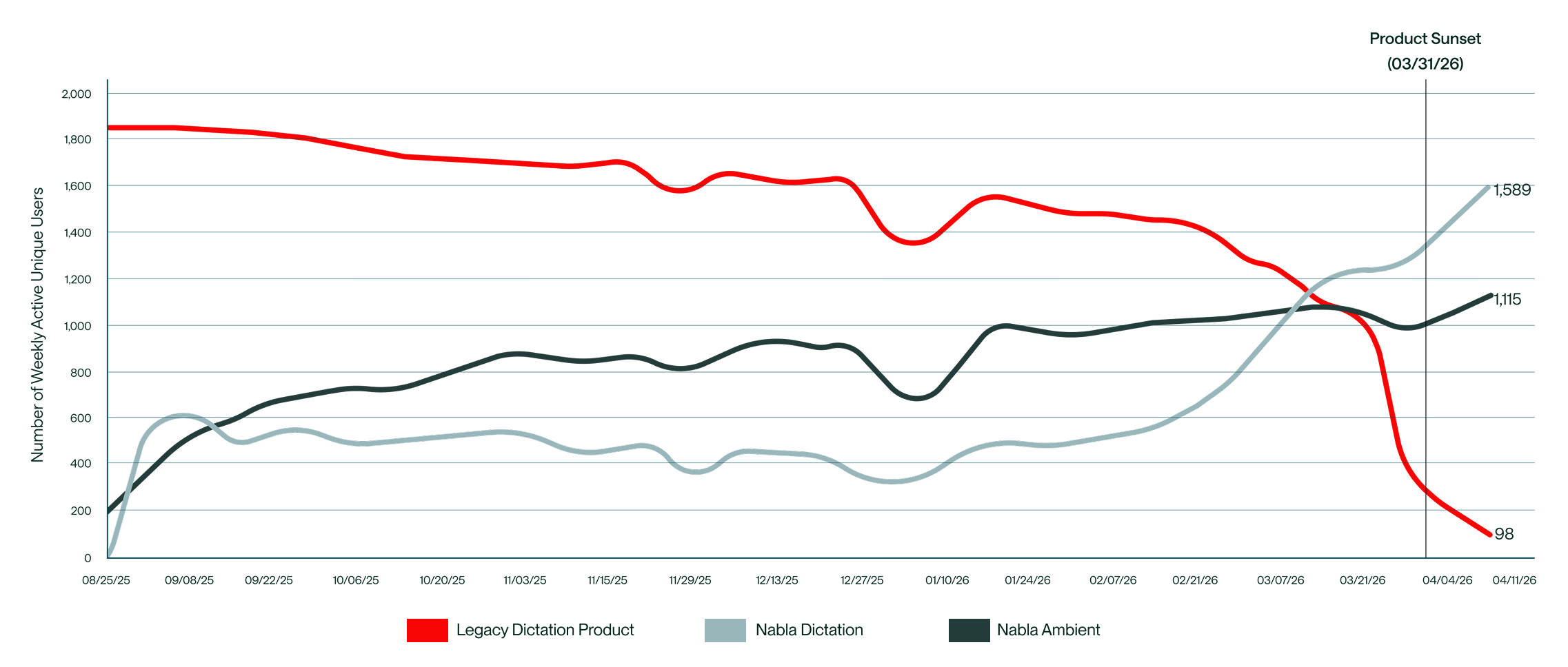
Key Drivers
98%
Nearly every physician using ambient AI experienced meaningful improvements, including reduced documentation burden and better patient visits, reinforcing the value of a unified documentation strategy across the organization.
16.3
Among their peers, physicians using ambient AI reported the strongest EHR experience, demonstrating that documentation improvements translated into a better overall clinician experience.

As adoption expanded across the enterprise, M Health Fairview also saw measurable improvements in encounter closure and level of service, demonstrating that a unified documentation strategy can positively influence both clinician efficiency and operational performance.
A Repeatable Model for Enterprise AI
By replacing fragmented documentation tools with a unified AI platform and investing in structured change management, specialty-specific enablement, and close operational partnership, the organization built a scalable framework for enterprise AI adoption across specialties and workflows.